
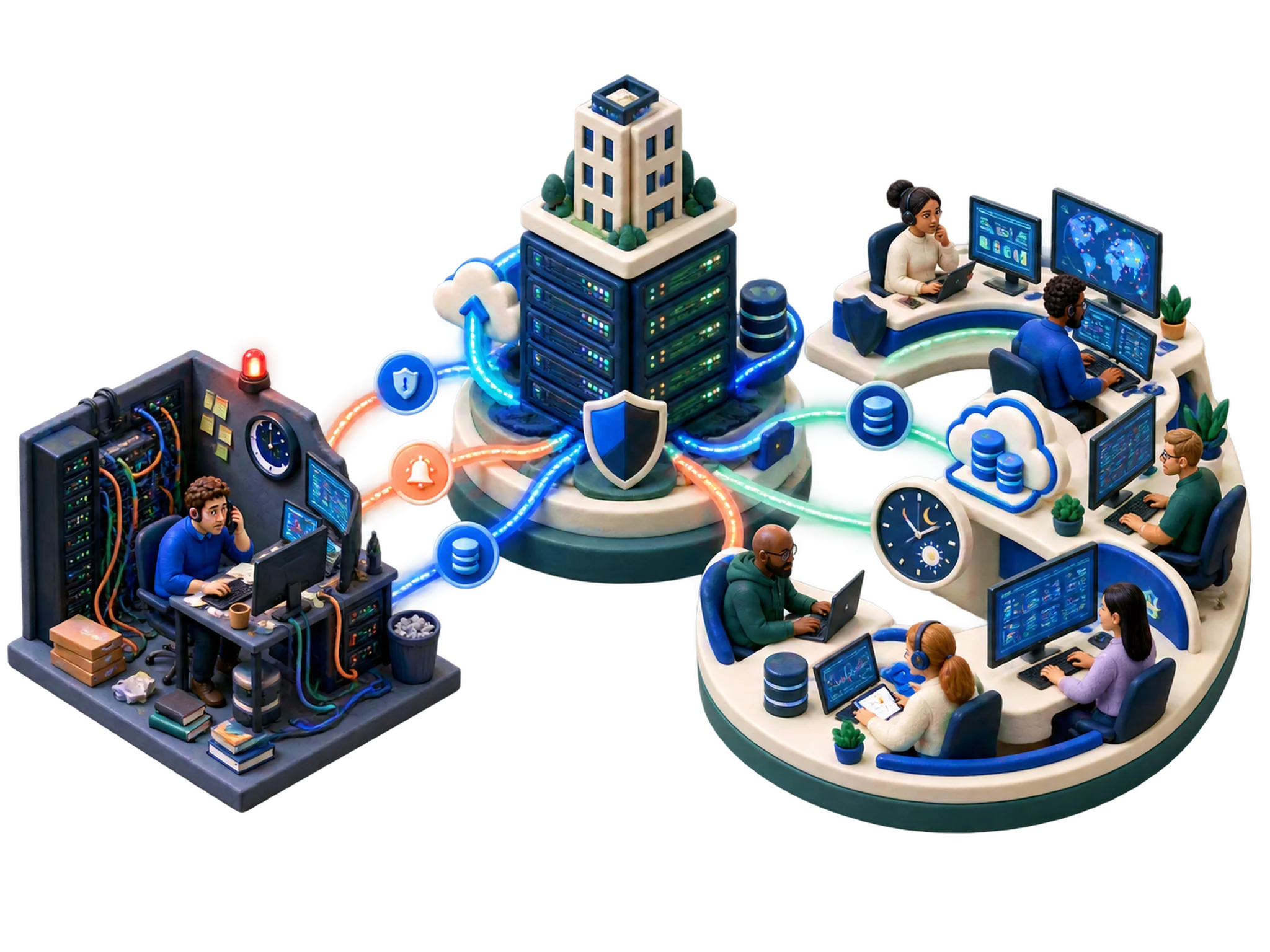
Every growing business eventually reaches a point where ad hoc IT support, someone in the office who is good with computers, stops being enough. The decision at that point is not really in-house versus managed, it is which combination of the two actually fits your risk tolerance and budget.
What Managed IT Services Actually Offer
A managed IT provider gives you a team of specialists across cybersecurity, cloud management, and compliance, along with a predictable subscription-based cost that simplifies budgeting compared to unpredictable one-off IT expenses. Coverage is typically continuous, since a provider is responsible for handling absences and after-hours issues, rather than depending on one or two internal staff members being available.
What In-House IT Actually Offers
An internal IT team has deep, specific knowledge of your systems, your people, and your history of past issues, and can respond immediately to on-site problems without a support-ticket queue. For businesses with unusual infrastructure or highly specific compliance needs, that depth of institutional knowledge is genuinely hard to replace with an external provider.
Where the Cost Comparison Actually Lands
In-house IT carries fixed costs, salary, benefits, training, and equipment, regardless of how much support is actually needed in a given month. Managed IT services replace that with a predictable monthly fee that scales more directly with usage, which tends to favor small and mid-size businesses without the volume to justify a full internal department.
Where Small Internal Teams Struggle
A small internal IT team, one or two people, has to cover an enormous breadth of responsibility: security, networking, cloud infrastructure, device management, and vendor coordination. Maintaining certifications and keeping pace with emerging threats across that whole surface area spreads a small team thin in a way that a specialized managed provider, with dedicated people per domain, typically does not experience.
The Hybrid Model Most Growing Companies Actually Land On
Many businesses do not choose exclusively one path. A common and effective pattern keeps a small internal presence for on-site, business-specific needs, while outsourcing specialized or around-the-clock functions, security monitoring, cloud infrastructure, backups, to a managed provider. This captures the institutional knowledge of an internal presence without asking two people to be experts in everything.
How to Decide for Your Business
If your technology needs are broad, specialized, and require continuous coverage, and you lack the budget or scale for a full internal department, managed IT is usually the more capital-efficient starting point. If your infrastructure is highly specific to your business, or in-house presence is a genuine operational requirement, a hybrid model that pairs a lean internal presence with managed specialist support tends to outperform either extreme.