
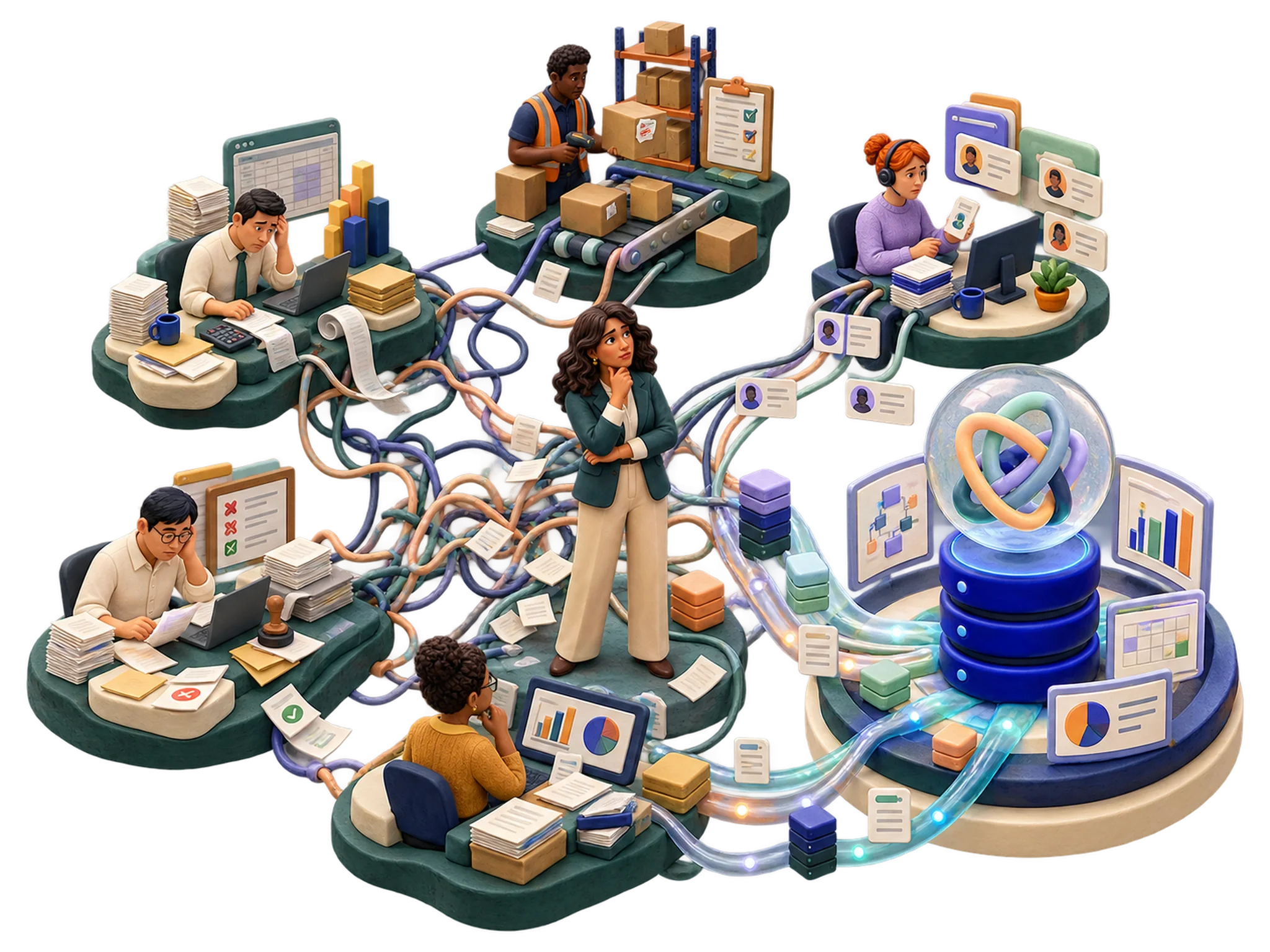
Most businesses do not wake up one day and decide they need an ERP system. They accumulate small operational pains, a spreadsheet here, a manual reconciliation there, until the accumulated cost becomes obvious in hindsight. Here are the signs worth taking seriously before that point.
1. Your Team Spends More Time on Spreadsheets Than on the Business
If employees are manually re-entering the same data across accounting, sales, and inventory tools, or spend hours every week on paper-based invoices and orders, that is time an ERP system can compress to nearly instant, and it is a strong signal you have outgrown manual coordination.
2. Departments Have Become Data Islands
Sales has its own records. Finance has its own books. The warehouse tracks stock its own way. Everyone is busy, but nobody has the full picture, because the systems were never designed to share data with each other in the first place.
3. Month-End Reconciliation Takes Longer Every Cycle
If consolidating financial information across systems and spreadsheets is taking noticeably longer each month, that is a sign the underlying data infrastructure has stopped scaling with the business.
4. You Don't Know Your Real-Time Inventory Position
If finding out how much inventory you actually have requires a manual count or a cross-check across systems, you are making purchasing and fulfillment decisions on stale information, which shows up eventually as stockouts or overstock.
5. Order Volume Is Starting to Outpace Your Systems
Businesses processing a high and growing volume of orders across multiple sales channels, their own site plus several marketplaces, commonly hit a wall where manual coordination between channels breaks down and customer experience starts to suffer as a result.
6. You Only Learn How the Business Is Performing at Month-End
Waiting until the books close to understand how the company actually performed means every operational decision in between is made with a lag. Real-time visibility lets you respond to a problem while it is still small.
7. Compliance or Traceability Requirements Have Outgrown Spreadsheets
If your industry requires an audit trail, quality traceability, or regulatory reporting, spreadsheets and disconnected tools become a genuine compliance risk, not just an inefficiency, once volume or scrutiny increases.
8. Customer Satisfaction Is Slipping as Order Volume Grows
When fulfillment accuracy and speed start declining as volume increases, that is frequently a systems problem, not a staffing problem, and it tends to get worse, not better, without a change in the underlying infrastructure.
9. Every New Integration Feels Like a Custom Project
If connecting a new sales channel, payment processor, or reporting tool always requires a bespoke workaround, your current systems were not built to scale, and each new connection adds fragile, hard-to-maintain complexity.
10. Leadership Is Making Decisions on Gut Feel Instead of Real Numbers
If the honest answer to how confident are we in this number is not very, the underlying data infrastructure, not the team's judgment, is usually the actual problem.