
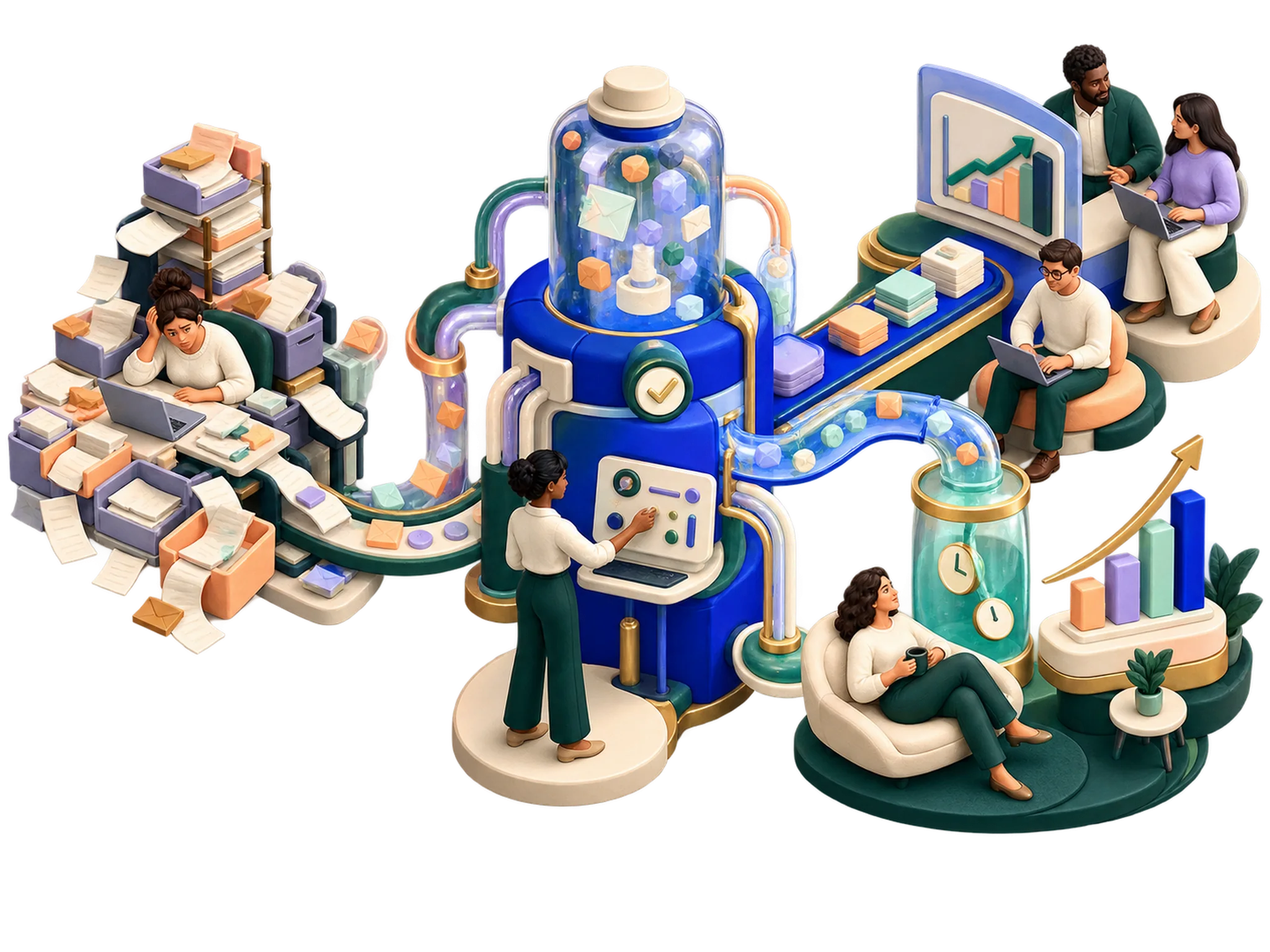
AI automation has enough hype around it that a reasonable business owner should be skeptical of any ROI claim on its face. The useful version of this conversation is not whether AI automation works in general, it is which specific workflows tend to produce a real return, and what a realistic budget and payback timeline actually look like.
Where AI Automation ROI Shows Up Fastest
Businesses tend to see the fastest, clearest ROI in workflows tied directly to labor hours or revenue capture: lead follow-up, customer support triage, scheduling, invoice processing, document cleanup, and recurring reporting. These are high-volume, repetitive tasks with a clear before-and-after that is easy to measure, which is exactly why they pay back quickly.
What Realistic Cost and ROI Looks Like
Off-the-shelf automation tools commonly run $200 to $800 per month for a small business. A custom-built system, one connecting tools that do not natively integrate, typically costs $2,000 to $8,000 upfront plus $200 to $500 per month to run, with larger custom workflows starting around $5,000 to $30,000 depending on complexity.
For businesses saving 15 or more hours per week, ROI is often positive within 30 to 60 days. A well-scoped custom workflow should have a clear 3 to 6 month payback target identified before the build starts, not discovered after the fact. If a proposed automation cannot articulate that payback math upfront, that is worth questioning.
What AI Automation Actually Reduces
The realistic gains are reclaiming 10 to 40 hours of manual work per week for the team members involved, and reducing operational errors substantially, often 60% to 90%, in workflows where the automation is connecting systems that previously required manual re-entry and cross-checking between tools.
Where AI Automation Tends to Disappoint
Automation built around a vague goal, make the business more efficient, without a specific workflow and measurable before-state, rarely produces a clean ROI story, because there is no clear baseline to compare against. Automation layered onto a process that is itself broken or inconsistent also tends to underperform, since it automates the inconsistency rather than fixing it.
How to Get Started With AI Automation
Pick one workflow with a clear, measurable before-state, hours spent, error rate, response time, and design the automation around fixing that specific number. Define the human review points explicitly rather than assuming full autonomy, since a workflow that reduces errors by removing a person entirely also removes a safety check. And treat the first automation as a proof point for the next one, not a one-time project.